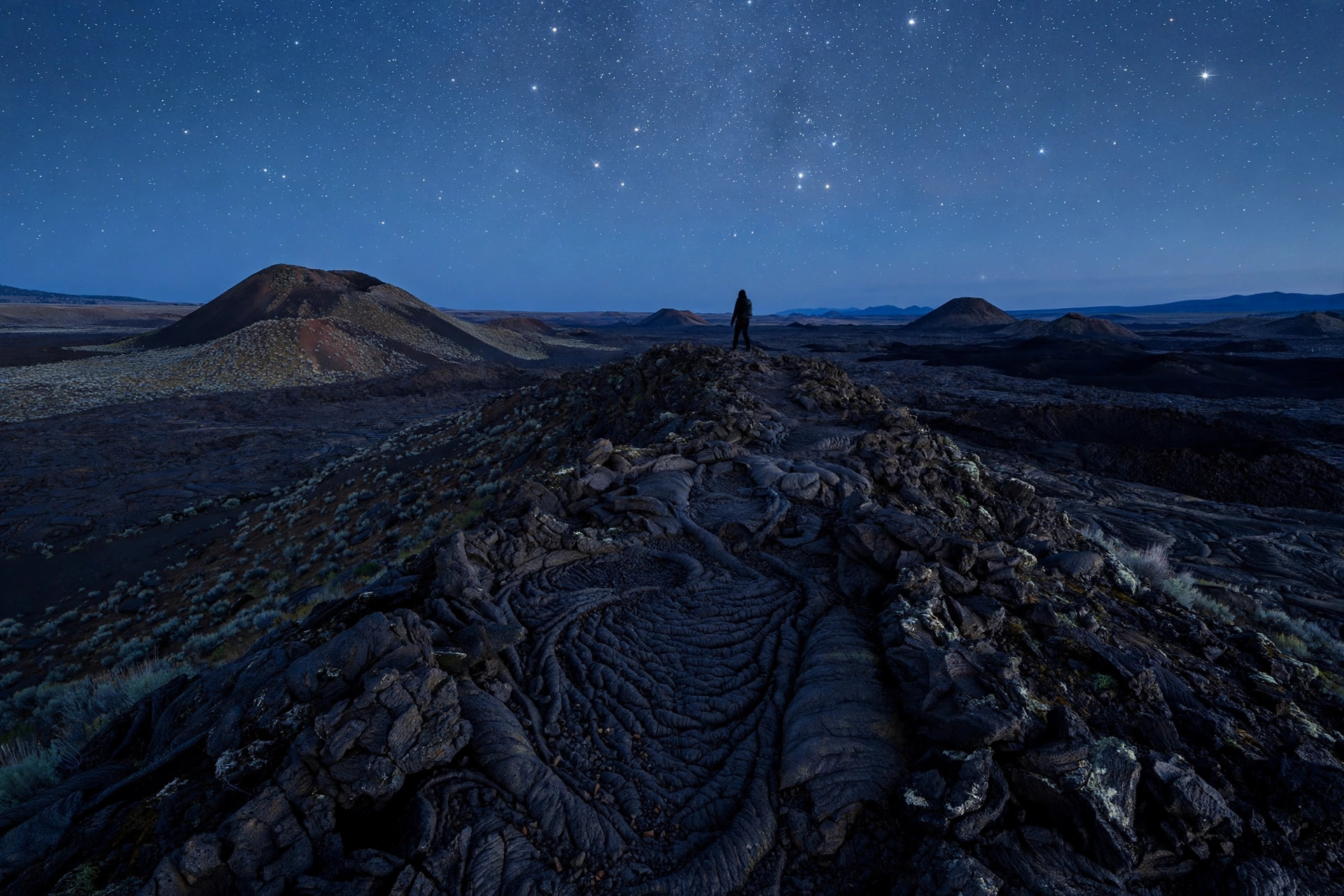
Somewhere in southern Idaho, the ground stops looking like Earth. Mile after mile of black basalt lava stretches to the horizon, broken by cinder cones and lava tubes — terrain so strange Apollo astronauts once trained on it. Craters of the Moon National Monument and Preserve is one of America's strangest park units, best seen in November: the crowds are gone and the nights are among the darkest in the country.
Why November changes Craters of the Moon
Timing matters. According to the National Park Service, the 7-mile Loop Road closed to vehicles for the season on 18 November 2026 and stays closed until spring. That changes the park for the better: the road becomes a quiet route for hiking, biking, snowshoeing and cross-country skiing. The park stays open 24 hours a day, and the Robert Limbert Visitor Center remains open daily, currently 9am to 4:30pm, with maps and ranger advice.
Come prepared for real cold. The monument sits at around 5,900 feet, and November days often barely climb above freezing, with snow always possible. Pack insulated layers, a warm hat and gloves, and sturdy boots for the sharp lava rock.
Walking the lava fields
Explore on foot from the visitor centre along the Loop Road corridor. The Devils Orchard Nature Trail is an easy, roughly one-mile paved loop through lava formations. Climb Inferno Cone for a panorama over the lava flows, then wander the North Crater Flow trail across a young, jet-black lava field. Bring water — there is none on the trails.
Inside the lava tube caves
Some of the park's best exploring happens underground. Indian Tunnel and Dewdrop Cave are open, reached from the Caves Trail, about a 1.6-mile round trip from the Caves Area. You need a free cave permit, collected in person at the visitor centre during opening hours — they protect roosting bats — plus a torch, as there is no lighting inside. Indian Tunnel is the showpiece, entered by stairs through a collapsed roof, with skylights overhead. Buffalo, Boy Scout and Beauty caves are permanently closed.
Stargazing in a Dark Sky Park
Craters of the Moon was certified an International Dark Sky Park in 2017, and its skies are rated Bortle 2 — about as dark as it gets, with the Milky Way in detail to the horizon. November brings roughly 11 hours of true darkness each night, and the Leonid meteor shower peaked on 17 November 2026, with late-November nights still worth watching. The park is open around the clock, so drive in after dark and watch from the lava fields — just dress for bitter cold and scout your spot in daylight first.
Planning your November visit
An entrance fee applies — currently $20 per private vehicle, valid for seven days. The Lava Flow Campground is open at $8 a night ($4 for Senior or Access pass holders), but it is walk-in only now, and snow camping needs a free permit from the visitor centre. The monument sits on US-20/26/93 between Arco and Carey — roughly three hours from Boise and 90 minutes from Sun Valley. Check NPS conditions before you travel — November weather can change fast.
A half-day November plan
Start at the visitor centre for maps and a cave permit. Walk Devils Orchard, climb Inferno Cone, then hike the Caves Trail into Indian Tunnel. As the light fades, find a viewpoint for the sunset over the black lava — then stay for the stars. In November, you may well have the whole strange landscape to yourself.
Related travel guides
- Death Valley in November: Salt Flats, Dunes & Desert Guide
- White Sands National Park in November: Dunes, Sledding and Sunsets
- Cuyahoga Valley National Park in November: Quiet Trails Guide
Tags: #CratersOfTheMoon #Idaho #NationalParks #DarkSkyPark #USATravel #LavaFields #Stargazing #NovemberTravel
Comments
Post a Comment