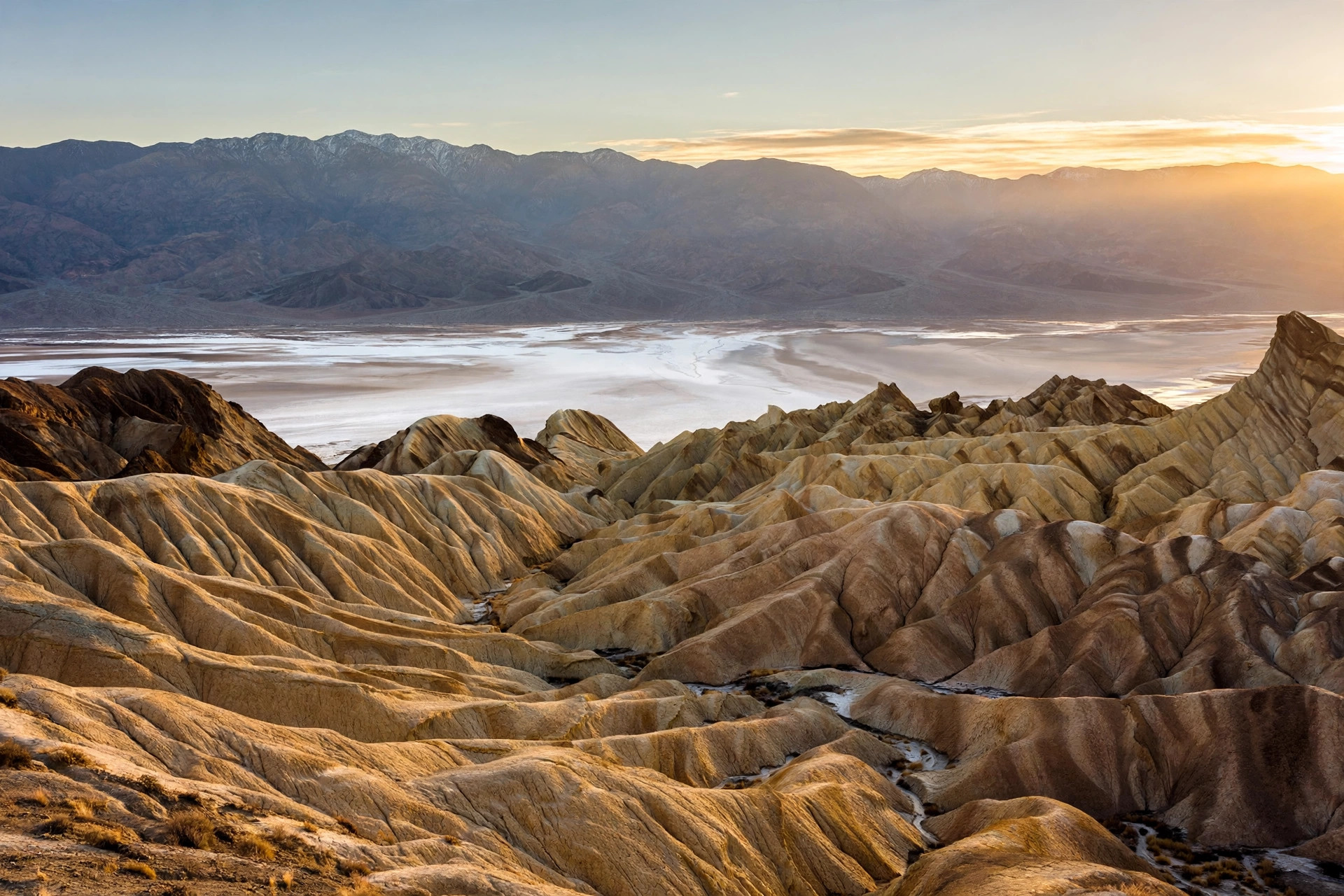
There is no better month to meet Death Valley than November. The furnace of summer has finally eased, the valley floor settles into mild, golden days, and the park's strangest landscapes — white salt flats, rippling dunes and painted hills — open up to walkers again.
Why Death Valley in November is the best time to visit
Death Valley is the hottest, driest and lowest place in North America, and from June to August it lives up to that reputation, with temperatures regularly passing 120°F. November flips the script: the park's morning report for mid-November 2026 put Furnace Creek highs around 73°F (23°C) and lows near 58°F (14°C). The National Park Service calls November through March the ideal season, and November brings thin crowds before the winter holidays. The park covers more than 3.4 million acres, about two hours from Las Vegas.
Badwater Basin: the lowest point in North America
Start at Badwater Basin, 282 feet below sea level — the lowest point on the continent. A boardwalk leads out onto a vast salt flat, where the crust cracks into white geometric polygons stretching to the horizon. A small sign on the cliff face marks sea level, high above your head. Go in the morning or late afternoon, when the low sun softens the glare, and allow 45 minutes to walk out to the salt's edge.
Sunrise at Zabriskie Point and the Mesquite Flat Sand Dunes
Set an early alarm for Zabriskie Point. A short paved walk brings you to an overlook above golden badlands that glow at first light, with Manly Beacon standing dark in the middle distance. Arrive 30 to 45 minutes before sunrise for a good spot.
Later, head to the Mesquite Flat Sand Dunes near Stovepipe Wells. There are no marked trails — you simply walk out across the rippled sand towards the highest crest you can see. Sunrise and sunset are the times to go, when long shadows carve the dunes into waves. Allow an hour or two.
Artist's Palette and Dante's View
Between the two, drive the one-way Artist's Drive to Artist's Palette, where mineral oxides paint the hills pink, green and gold — best in late-afternoon light. If time allows, climb to Dante's View for a sweeping panorama of the valley floor far below.
Practical tips for a November trip
Getting in: the entrance fee is $30 per private vehicle, valid for seven days. There is no public transport inside the park and no shuttle, so a car is essential — and fuel, food and water are concentrated at Furnace Creek, Stovepipe Wells and Panamint Springs, so fill up before you head in.
Water and safety: even in November, carry plenty of water — park guidance suggests at least a gallon per person per day — and remember that mobile coverage is patchy or absent across most of the park. Tell someone your plans before a longer walk.
Road closures to know: after early-November 2026 rain, Titus Canyon Road, Scotty's Castle and the Cottonwood and Marble Canyon roads were closed. The main paved roads were open, but check the NPS Alerts & Conditions page on the day you travel.
A two-day Death Valley itinerary
Day one: sunrise at Zabriskie Point, then Badwater Basin and Artist's Drive in the morning, Dante's View in the afternoon, and sunset among the Mesquite Flat Sand Dunes. Day two: a morning canyon walk — Golden Canyon is a gentle favourite — then Ubehebe Crater, with a stargazing stop after dark — Death Valley is an International Dark Sky Park, and a November night sky here is something you will not forget.
Related travel guides
- White Sands National Park in November: Dunes, Sledding and Sunsets
- Cuyahoga Valley National Park in November: Quiet Trails Guide
- Congaree National Park in November: Boardwalk & Fall Colour Guide
Tags: #DeathValley #NationalParks #California #USATravel #DesertTravel #RoadTripUSA #NovemberTravel #TravelGuide
Comments
Post a Comment