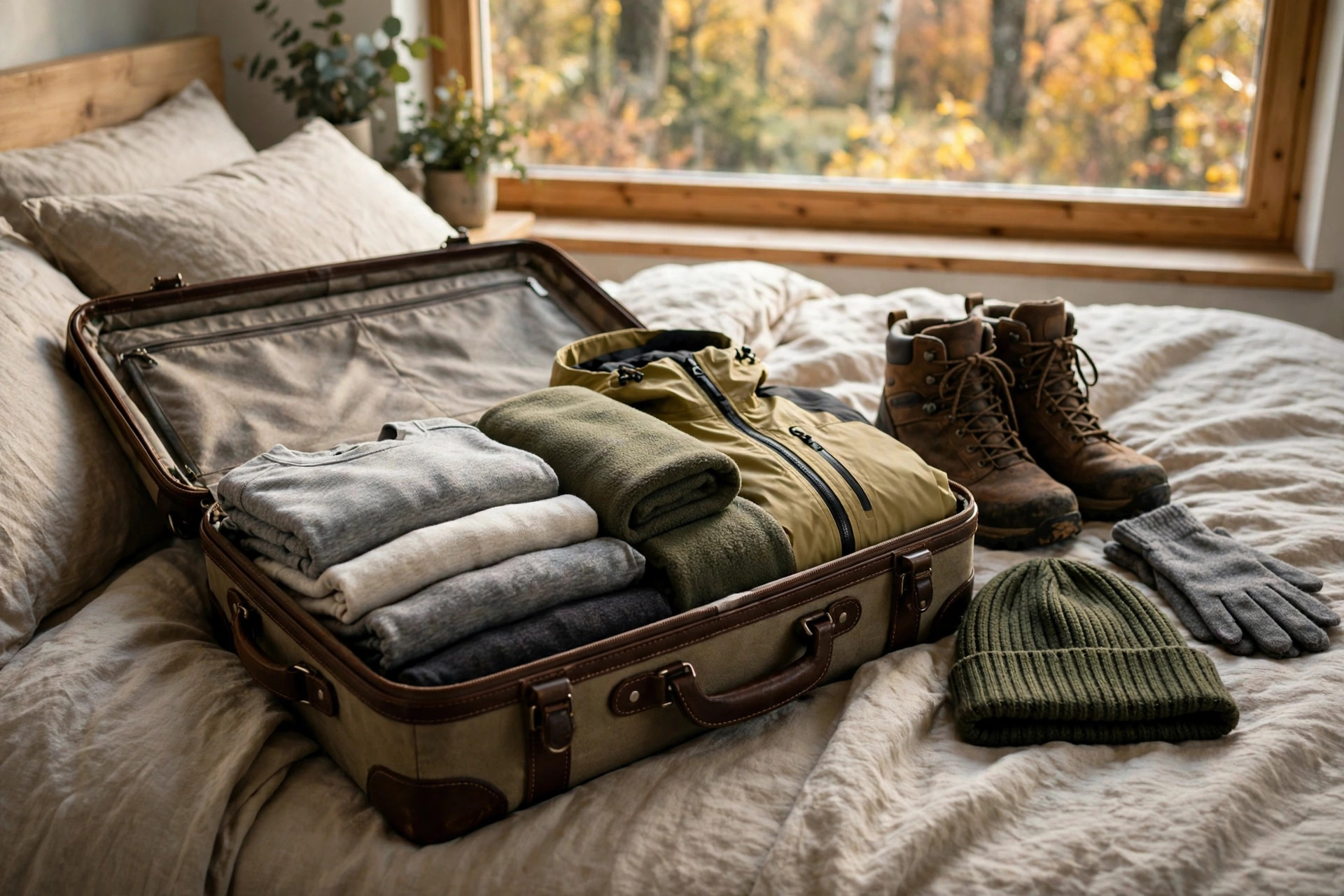
November is the trickiest month of the year to pack for a trip across the United States. One itinerary can take you from a crisp morning in New York to desert sunshine in Arizona and a snowy mountain pass in Colorado, all in the same week. The answer is not a bigger suitcase. It is a smarter system: layers you can add or shed as the weather changes.
The three-layer system that works everywhere
Packing guides and outdoor specialists agree on one principle: build your clothing around three layers rather than one heavy coat. Start with a moisture-wicking base layer in merino wool or synthetic fabric — never cotton, which stays damp and chills you once you stop moving. Add an insulating mid-layer such as a fleece or a lightweight down jacket. Finish with a waterproof, windproof shell that blocks rain and gusts. Worn together they handle a freezing morning; worn separately they cover a mild afternoon.
This system also saves space. A packable down jacket and a thin shell weigh less than a single bulky winter coat and work in far more conditions.
Packing by climate: desert, mountains, coast and city
November weather in the USA is really four different trips in one. Pack for the coldest place on your route, then add light pieces for the warm ones.
Desert and the Southwest
High desert days can feel like a mild spring afternoon, yet temperatures can fall by as much as 40°F once the sun drops behind the canyon walls, according to desert packing guides. Pack a warm hat, gloves and an insulated jacket even if the daytime forecast looks balmy. Sun protection still matters at altitude, where UV is stronger and bright sand and rock reflect it back at you.
Mountains and ski towns
Mountain resorts open for the ski season in November, and the Grand Canyon's South Rim sits at around 7,000 feet, so cold and wind arrive early. Bring a thermal base layer, waterproof boots with good grip, a warm hat, gloves and a neck gaiter.
Coasts and cities
Autumn in the Northeast and Midwest brings cool, crisp days, while the South stays warm — so a light jacket, jeans and comfortable closed walking shoes cover most city days. Add a compact umbrella and a waterproof shell for coastal rain, and remember that strong indoor air conditioning in the South makes a cardigan or light layer useful in restaurants and on long-distance buses.
The carry-on essentials travellers forget
Keep liquids in containers of 3.4 ounces (100 ml) or less, packed together in one clear quart-size bag, as the TSA requires. Since July 2025, travellers no longer need to remove their shoes at standard TSA screening — though rules can change, so check the TSA website before you fly. Pack a reusable water bottle, a portable charger, a small first-aid kit, any medication in hand luggage, and a US plug adapter if you are visiting from abroad.
A two-day packing checklist
Use this as your starting point, then adjust for your route. Clothing: two merino base-layer tops, one fleece or light down jacket, one waterproof shell, two pairs of trousers, warm socks, a hat and gloves. Footwear: comfortable walking shoes plus waterproof boots for mountains or wet coasts. Kit: sunscreen, lip balm, a compact umbrella, a daypack, a reusable bottle and a charger. And one rule worth remembering: the CDC notes that hypothermia can occur even above 40°F when rain, sweat or cold water chills the body, so a dry layer is safety kit, not comfort kit.
Related travel guides
- Death Valley in November: Salt Flats, Dunes & Desert Guide
- Jackson Hole in November: Ski Opening, Tetons and Town Square
- Tucson in November: Saguaro, Desert Museum and City Guide
Tags: #USATravel #PackingGuide #NovemberTravel #TravelTips #WinterTravel #PackingList #USARoadTrip #TravelUSA
Comments
Post a Comment